Conservation in Action

Current Conservation Projects
Our team supports a variety of conservation programs and projects, including partnerships with local and international organizations.

Stranding Response Program
Our Stranding Response Program coordinates responses for all marine mammals and sea turtles on Virginia's 7,000 coastal miles. This nationally-recognized team of staff and volunteers works 24 hours a day and 365 days a year responding to stranded animals, providing exceptional rehabilitation medical care, and biomedical examinations. Since the program's inception more than 30 years ago, the team has responded to over 10,000 stranded marine mammals and sea turtles.
About Stranding Response
OspreyWatch
OspreyWatch is a global monitoring project where citizens and scientists collect data on breeding osprey. We work with the Center for Conservation Biology to monitor osprey nests and chicks on the Lynnhaven River, home to the largest population of breeding osprey. The collected data will help address global climate change, depletion of fish populations, and environmental contaminants.
About OspreyWatch
SAFE Sea Turtle
In May 2015, we led the formation of the Association of Zoos and Aquariums’ (AZA) "Saving Animals From Extinction" (SAFE) Sea Turtle program, and since then have continued to utilize the collective resources of the AZA community to secure sustainable populations of all sea turtle species. Our facility contributes research and funding to the SAFE Sea Turtle program to protect sea turtles globally, with a special focus on critically-endangered Kemp's ridley sea turtles and Eastern Pacific leatherback sea turtles.
About SAFE Sea Turtle
SECORE Coral Restoration
The Virginia Aquarium is home to a wide variety of live coral species including our very own coral lab, and we recognize the correlation of healthy coral to healthy oceans. As a silver partner with SECORE, we provide financial support, field research, and participation in their annual scientific study in Curaçao. We have been working with SECORE since 2015 to master these techniques for coral rearing and to help with the research associated with restoration efforts.
About SECORE
SAFE Coral
Saving Animals From Extinction (SAFE) is a collaboration among members of The Association of Zoos & Aquariums (AZA) with field-based partners aiming to conserve threatened species. The Virginia Aquarium provides research and financial support to the AZA's SAFE Coral program, which aims to build a world where coral reefs are abundant, healthy, and genetically diverse.
About SAFE Coral
SAFE Shark and Ray
Our facility contributes research and funding to the Association of Zoos & Aquariums' (AZA) Save Animals From Extinction (SAFE) Shark and Ray program, whose goal is to deliver effective action for the conservation and recovery of sharks and rays. These predators are essential to balancing marine ecosystems worldwide, yet up to one third of these species may be threatened with extinction.
About SAFE Shark and Ray
E-Cycling Events
Our team hosts E-Cycling Events annually to collect old electronics along with other waste materials for safe and responsible disposal. Since 2009, we've collected nearly 700,000 pounds of e-waste! Learn more about these events and how to get involved through volunteering.
About E-Cycling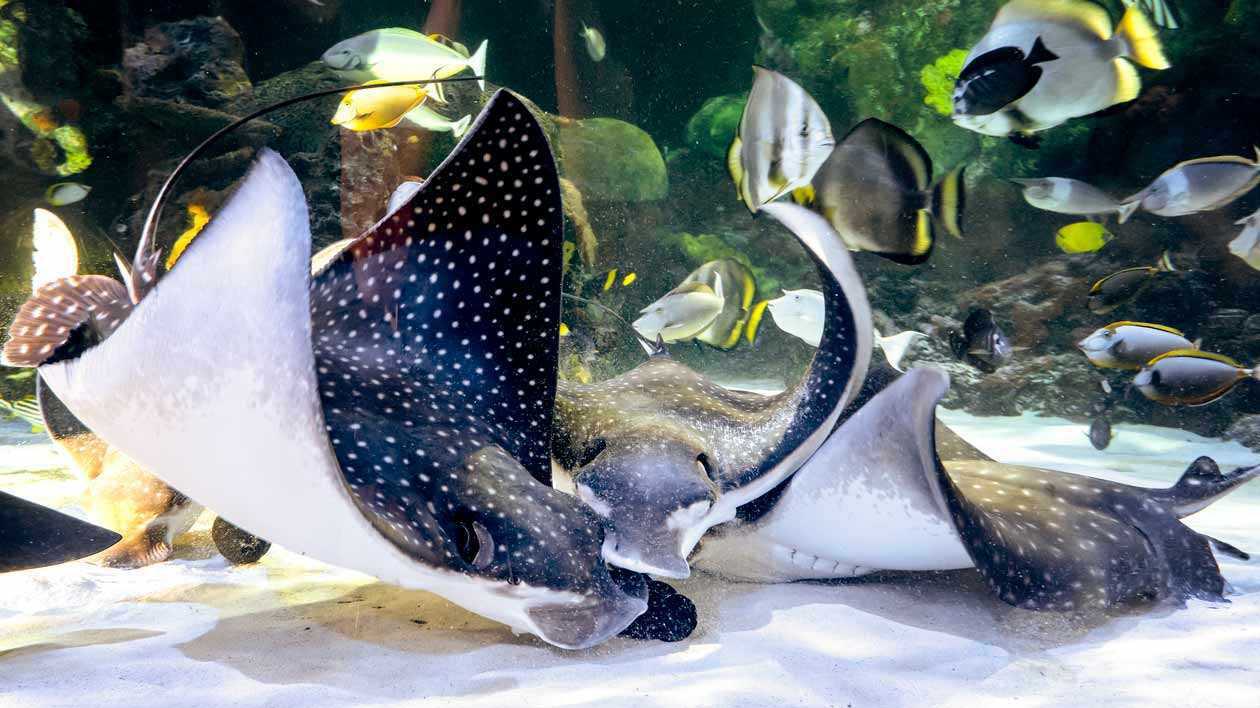
Spotted Eagle Ray Species Survival Plan
As home to two female spotted eagle rays, we participate in the Spotted Eagle Ray Species Survival Plan (SSP). This SSP gives breeding recommendations and provides aid with acquiring this species from participating facilities. We are proud to have been one of the few organizations in the country that has had success with breeding and rearing of the species.

Lake Victoria Cichlid Repopulation & Reintroduction
We are supporting the repopulation and reintroduction of cichlids by breeding on-site and managing breeding at other Association of Zoos and Aquariums (AZA) institutions. Creating a larger and genetically diverse population will allow us to reintroduce the species to their natural habitat in Lake Victoria; restoring the natural ecosystem and providing a more stable fishery to the people in the area.

Tomistoma Task Force
We support the Tomistoma Task Force through conservation, research, establishing husbandry guidelines, and promoting the species through events like World Tomistoma Day to raise awareness about these crocodiles. The Virginia Aquarium is home to one of five breeding pairs of Tomistoma in the country and the sixth American facility to have breeding success resulting in two hatchlings. The hatchlings' presence has introduced the first viable new genetics to the population in almost 50 years.
About the Tomistoma Task Force
Komodo Dragon Species Survival Plan
The Indonesian-based Komodo Species Survival Plan (SSP) carefully monitors Komodo dragon populations; gathering and storing vital conservation data. We aid in this mission by giving financial support, spreading awareness, and helping to maintain viable Komodo dragon populations through breeding programs.
About the Komodo Dragon Program
StAR Zebra Shark Project
The Stegostoma tigrinum Augmentation and Recovery Project (StAR) is a collaboration of the Association of Zoos & Aquariums (AZA) facilities working to establish a healthy, self sustaining population of zebra sharks in Indonesia through breeding and juvenile release programs. We are one of the founding partners of the StAR program and one of 105 supporting facilities.
About the StAR Project
Water Quality Lab
Approved by the Commonwealth of Virginia's Department of Environmental Quality, the Virginia Aquarium's water quality lab can process water samples from community members interested in monitoring local waterways. You can participate as well!
About the Water Quality Lab